Posts

I spent around 10 years of my career writing all sorts of automation - I don't think automation is a good thing

Image
I spent around 10 years of my career writing all sorts of automation. Whenever I hear another company working on yet another breakthrough in automation it gives me a bitter smile. Let me explain why. (and it is not another `automation is impossible` rant) The other day I was having breakfast at McDonald's, where I noticed how few employees they had on shift, yet able to serve quite a few customers. I worked at McDonald's and I remember that cashier work was particularly challenging - usually one had to take orders and prepare orders at the same time, all in 120 seconds 9 (it was in Russia 20 years ago, I might be slightly wrong with figures, but you get the point). A Cashier was also supposed to smile and let you feel welcome. Now they have self-checkout stations, leading to funny results: Order preparation is nowhere near 120 seconds. It takes ages now, to be honest. They employ fewer people. You know, crew members at McDonald's don't usually have a line of job of...

Efficient test automation - Secret #1 | Test Club

Image
It seems everyone talks about efficient test automation, but not so many people have actually seen it! To cover this I decided to make several videos regarding the secrets of efficient test automation. Today we will talk about the first (and, arguably, the main) secret - realistic expectations. Very often, test automation projects or initiatives are started with the following unrealistic expectations: "Test automation will replace 'manual' testing" "Test automation will provide fast results and benefits" "Test automation efficiency depends solely on test automation engineers" Unfortunately, all those expectations are not realistic! Watch the video to know more!

The biggest damage of COVID-19 pandemic may be caused by us

Image
Arguably, the biggest damage made by the pandemic is the decline in people's trust and morale. That is the common plot for a horror movie - a group of people get locked in one place. Then something goes wrong, people get suspicious towards each other, then kill each other one by one, only to learn that it was someone's else evil game. Congrats folks - now we can find ourselves living in such movie. Today in one of the social networks somebody has complained that the cashier at the local shop, who was appearing in his 70s was coughing for 15 seconds. The person complaining was scared that cashier might be spreading COVID-19. The comments were divided. The minority has, rightfully, mentioned that coughing may be as well a symptom of quite common long-term conditions, which pose no threat to the public - like Asthma or Lung Cancer. The majority though were getting quite critical or even aggressive. People would suggest that those exposing any COVID-like symptoms should be ...

Why working-from-home tax is a bad idea

Image
First of all, I have to admit, I am not a professional economist, tax-expert or politician. Even though I do have basic economic education, I might miss some obvious things. Nonetheless, I think that the idea of additional tax based on where people decide to work from (which is a `telecommuting` in this case) is not a very sound suggestion Like many other people, I am working from home now. The biggest difference in my case is that I was working from home before and I intend to work from home in the future. I don't mind (in fact, I strongly support) seeing my colleagues once a week or several times a month, but I don't think it always makes sense to be collocated to work effectively. This morning I saw the story posted by the BBC:  Deutsche Bank: Tax working from home 'to support vulnerable jobs' , which suggests introducing a new 5% tax for those, who choose to work from home. I am not going to copy the story here, please feel free to check it yourselves, but I...

Test automation framework - do I need it at all?

Image
While there're lots of information published on the internet about how one should develop/buy a Test Automation solution, there's an elephant in the room - which is the fundamental question "Do I need to do it at all?". That is a good question. While I think that there’re some legitimate contexts where product/project/team can benefit from having a sophisticated test automation solution/framework, my general rule of thumb is “If you need a framework - you do it wrong” . There’re at least several decent papers showing the benefit of unit-testing ([1],[2], [3]), while I could not find any research proving that system level tests could bring better results. Please let me know if you can prove me wrong. There’s at least one half-scientific paper showing the benefits of unit tests in comparison to integration/system level tests [4] There’s a good paper bringing a notion of running/writing and maintaining test vs. the benefit of having/running it at...

An alternative to ubiquitous UI-level checking - Subcutaneous tests

Image
Let's assume a hypothetical situation - you were assigned to a project to help with the "test automation" initiative. You have a huge "test plan" as an input, containing hundreds (if not thousands) of "test cases" and you need to do something about it, quick. Problem statement Your first urge (if it is a Web application) may be to write some UI-level automated checks using tools like, you know, Selenium. In fact, there's a huge demand for such "Selenium test automators" in the industry these days. But please, please, don't do this. There're lots of things which make UI-level automated checking the least desirable approach: UI-level automated checks will be slow. There's just no way to avoid it. You can parallel them or do some other tweaks to speed them up somehow, but they still will be slow. UI-level automated checks will be flaky. Partly - because they're slow. Partly because Web browser and UI interface w...

There's no such thing as "Best Practice"

I don't usually write replies to someone else's articles or blog posts. But recently I stumbled upon an article, which I would like to reply to. The article named "10 Best Practices and Strategies for Test Automation" (original can be found here:  https://www.softwaretestinghelp.com/automation-testing-tutorial-7/ ) states: These strategies are taken from my own experience plus from the literature of testing gurus like Michael Bolton, James Bach and Cem Kaner. These practices should be followed in every automation project. Ironically, James Bach has a great post named "No Best Practice" ( http://www.satisfice.com/blog/archives/27 ), in which James puts his view related to "Best Practice" idea, which can be briefly summarized - There's no such thing as "Best Practice" . I wholeheartedly support this viewpoint. A similar idea is stated clearly on the very home page of Michael Bolton website ( https://www.developsense.com/ ). Simp...

A problem with Agile, automated testing and frequent releases

Intro I turn on my TV-set. I start my favourite TV application to watch a TV-show. It says there's a new version and insists on updating. Would I have access to new TV-shows or movies after this update? Not at all! Would this application work faster after that? Hardly. Would it be more stable? Hopefully, but no guarantees. What would this update give me? New UI (I was OK with the old one). Ability to choose which trailer I would like to watch (like I need more than one). It eats my internet traffic and time and gives me nothing of value in turn. I need to sort out my finances. I take my cell phone. I start an accounting application that works with my bank. It wouldn't start. Connectivity issue - it says. In reality - what I need is to go to Google Play and update the application. After the update, it looks slightly different, has some new feature I don't need and would hardly use and obfuscates previously learnt path to the features I need. The problem Both...

Some tip to fix flaky Web UI tests

Test automation at the Web UI level (you know, Selenium stuff) is usually brittle and painful. It is usually also the only test-automation approach people are aware of/interested in (for whatever reasons). Below are several suggestions on how one can make her/his UI test automation at the Web UI level less painful and flaky. 1. Retry failed steps Each test consists of several steps. Unfortunately, those steps from time to time tend to fail with no apparent reason. Retrying a failed test step may save your whole test from failing. Helps with: Unresponsive, slow UI Elements being shown with a delay Wrong moon phase [1] Drawbacks: Sometimes it is just a waste of time, especially when the real issue is being "retried" Even worse: sometimes it may hide real issue that would go away after some time or page refresh 2. Retry failed tests From time to time - odds are just against you with a specific test run. Everyone, whoever had the misery of working with Web UI...

Tic Tac Toe computer player algorithm via TDD

Some time ago I had an argument with another team member - he was claiming that Test-driven development (TDD) was not applicable to our application. He thought it would be more efficient to rely on manual or E2E testing instead. I disagreed. Without going too much into the details, the core of the application we were working on was a graph-traversing algorithm with some amount of mathematical calculations. It was painful to test on a system level as the number of possibilities was huge and it was not easy to put the system into a particular state to check specific conditions. I thought that thorough unit-test coverage, and, ideally, TDD would be more efficient, but was not able to persuade my colleague. At the end of the day, I started to doubt if I was right. Challenge was accepted, so I tried to do something more or less similar (though simplified) - implementing a Tic Tac Toe computer player logic via as pure TDD as possible. Long story short, after some time I managed to g...

Test automation framework architecture. Part 2.2 - Two-layered architecture

Image
As we've learned in previous posts of the series - Layered (also known as Tiered) architecture is a de-facto standard of the industry. There're two major variations of this architectural pattern that one should be aware of: 3-layered architecture (described here ) and 2-layered architecture . This post is going to concentrate on 2-layered architecture . 2-layered architecture is typically seen in UI-specific test automation frameworks. The key feature of this pattern is the absence of Business-layer, so most of the business-related logic are actually to be put into Page Objects. In order to avoid " The God class " anti-pattern and still be able to contain business-related logic in Page Object, one usually uses libraries or frameworks that allow simplifying DOM-elements location, thus letting Page Objects to concentrate less on locating elements and more on business-logic itself. The good thing in this architectural pattern is that it actually allows you...

Agile, testing and more frequent deliveries.

Yet another time I think I see people using word Agile wrong. Yet another guy claimed "we need to have more predictability and stability so I think we would go for Agile methodologies, Scrum in particular". Nonsense. I don't think that "predictability, stability, whatevershitability" has anything to do with Agile. If you start Agile transformation with such a goal you've already failed. Agile is about maximizing value delivery rate in a state of uncertainty, that's pretty much what it is. If your business is uncertain as hell why do you think that "predictability" with engineering teams is going to fix things? It is not. Worse, if you make engineering teams predictable while having unpredictable environment, you will miss the whole point and make things worse while still thinking you're doing fine. Nonsense. An agile team is about removing management layers between engineering and customer, not making management happier. ...

Test automation framework architecture. Part 2.1 - Layered architecture example

Image
Let's consider an example of what Layered (Tiered) architecture may look like for a test automation framework. As a system under test, we're going to use this simple and neat "Todo list" application. First, let's do a brief analysis of the application. From my brief exploration I came up with the following checklist: Area/Group Things to check Comments Todos CRUD 1 Create item Basic scenario, UI-level case 1.1 Create an item with the same name The case is not valid. There's no validation for that - nothing to check really. 1.2 Create an item with an empty/not valid/malicious name While it would be a nice thing to test manually, from test automation standpoint I would expect this to be filtered on service or repository level, so either integration or unit test . 2 Mark item complete Basic scenario, UI-level case 2.1 Un-mark item complete Basic scenario, UI-level case 3 Delete item Basic scenario, UI-level case 3.1 Delete item ...

Why I would prefer writing 100 unit test to one UI test

Choosing between writing one UI tests and 100 Unit test I would always prefer the second option. Why? Well, I am actually lame with UI testing, but that not the main reason. The only thing I worry about is speed. How fast we can change software? Quality - I don't care about it much cause quality standards are contextual and can change. The only thing that is certain - there're going to be changes and we most likely don't know what those changes are about. So there's only one thing that matters - how fast we can adapt to this change. Internal quality is something that actually makes us able to change fast. UI tests do not contribute to internal quality. UI tests may even make things worse. That is the reason. And I invite you to Testcon Moscow to talk about this more - I am going to present some more thoughts on this topic there.

Manual and automated testing confusion

I am getting tired of posts about how "automated testing" going to replace "manual testing". Let me offer you a simple analogy. I have a car that has lots of useful self-check lights, like "check engine", "low gas", "low battery", etc. Automated tests are similar to those lights - if a light is on, most likely something is wrong and I need a mechanic to look at my car. Does having those self-check lights let me not to visit a mechanic for human-driven check yearly? They don't. Fact that self-check light is not on does not mean my car is OK, does it? Areas covered lots with self-check may require less time to check (as risk they would be broken is lower). However, there are lots of areas that is not feasible to cover with self-checks. There're some car parts I am not even aware of, while mechanic knows they weak points and can find an issue in a couple of minutes. It is possible to have only automated checks and not have ...

Perceived quality level of a software may have dropped, but testing is not the answer.

"Modern software is of a lower quality that it was in a past". Maybe. Perceived quality of software may have decreased, but I don't think that "more testing" is a proper solution. More testing does not mean more quality More testing may find more issues, but not necessarily. Simply spending more time on the activity does not mean results would be better. And somebody needs to fix bugs, test bug fixes. So we can't tell that more testing means more quality but certainly means bigger costs. Software quality != No bugs Bugs matter, but that's hardly the only factor to measure quality level. There are a whole bunch of other things that matter: UX, number of features, documentation, price, delivery model, cute logos... Spending more time on testing may mean spending less time on these things. Adequate quality level So it is obvious that one can't spend 100 years testing every possible case. I think that each product has some Adequate le...

Agile is not the goal, but means

Image
So we sit in the room and discuss the transformation plan for a company which was working in a waterfall manner for nearly a decade. The final goal is to switch to iterative development with somewhat small iteration (let's say, 3 weeks). The "only" problem we had is that we have 3 weeks if manual regression, and it does not really fit the plan. We have options: Long waterfall-like sprint, where the first half of the sprint we develop features, second half - test them Series of short sprints and one "hardening"/"release" sprint dedicated to regression when we finally decide to release things.  There's a third obvious option, which is to decrease regression time, but no-one seems to have knowledge about how it can be done in the next 5 years. So this gets dropped. "We need to have potentially shippable increment each sprint, "hardening" sprints are not Agile!" - says one man in a room. Well, that may be true. Maybe ...

Two different views on Test Automation

Image
I have published several posts with the aim to deliver one message - sometimes it is more efficient (fast and convenient) to change the application under test (make it more testable or eliminate the need for testing at all) then invent or employ complicated test automation techniques to check the same functionality. Even though there was a lot of misunderstanding caused by badly forming those posts, I still think I stroke something deeper. For instance, this twitter post made me think that we speak two different languages: That's like asking a pharma company to self-certify that their drugs are safe without any independent approval! #softwaretesting #CIO — Ayush Trivedi (@ayushtrivedi) 4 September 2017 Now it started to seem to me that there're two different views on what test automation is. First, probably prevailing point of view is that test automation is a part of ages-old traditional QA process, where test automation specialist is just a test specialist usin...

The broken concept of a Page object, or Why Developers Should Be Responsible For Test Automation

Image
Preface: I am in the middle of writing a series of posts about test automation frameworks architecture. I am still going to continue that series, even though this posts kind of devaluate the whole test automation framework concept a bit. Sorry for that, just can't stop ranting. Looking through the internet I spotted a couple of posts where some test automation specialists were talking about "page object" "pattern"/"model", as it was something special they had invented. Well, I also have something to say about "page object". “Java test automation engineers were told that there are different patterns than a PageObject” ( http://classicprogrammerpaintings.com/post/153817288474/java-test-automation-engineers-were-told-that ) "Page object" may be described as a pattern that allows us to decouple things you can do with the web page (external interface describing test/business logic) from the real implementation code you will h...

Test automation framework architecture. Part 2 - Layered architecture

Image
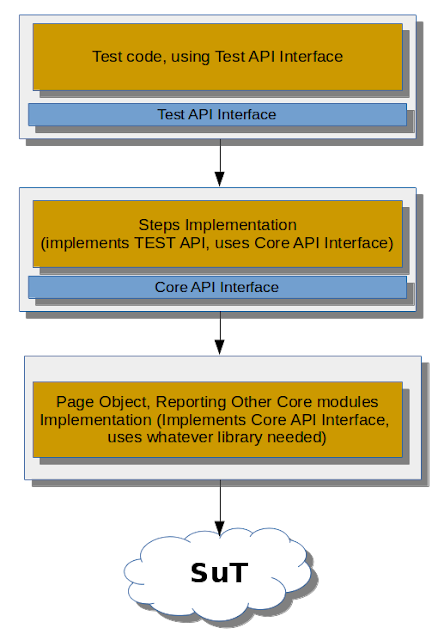
Probably the most popular architecture pattern used for test automation frameworks (TAF) is layered architecture. This pattern is so well known that on job interviews for some companies when they ask you about TAF architecture you are supposed to describe this one. If you don't - they think you know nothing about the architecture altogether. I suggest you first read a brilliant description of the pattern at the O'Reilly web page , cause in this post I am going to describe the pattern in a way it is usually applied to build test automation solution. Usually, there're three distinct layers, which may have different names, but follow the same logic mostly. Sometimes those layers called test layer , business-layer and core layer , but there're no standard names really. Key rules for layered architecture are the dependency direction (each level depending on the level below) and call direction (no level can call/reference code described in the level above). The rough...